Statistics show that promotional products are effective; 85% of people will remember the brand. For start up companies it is imperative to create a positive image right from the beginning. In the article, they discuss how digital marketing has grown but, that promotional products are still shown to be the most successful form of advertisement.
Here are some companies that used promotional products at their start and saw the benefits that followed:
- New Relic– This performance analytics company gained attention by using promotional products as part of a giveaway. Back in 2012, shortly after the company started, they offered a free trial of their platform. As a way to thank those who committed to taking the trial, they gave out over 75,000 t-shirts to customers. They even had different styles of the shirts instead of one, boring design!
This slideshow requires JavaScript.
- IFTTT-Socks! Socks! Socks! I was able to find numerous articles about IFTTT and how they gained fame though printed socks. What a cool idea, right? IFTTT (If this, then that), is a start-up tech company that has created a lot of buzz. Not only do they provide a good service but the unique, argyle printed socks were also a great way to promote their service. The socks were for a perfect gift for their techie clients and gained a lot of attention on social media.

- Twitter– This promotional product success story took place sometime after its start-up. We traditionally think promotional products are for clients when gifting promotional products to employees is highly effective as well. Twitter decided to put together a promotional “swag” bag for its employees which included a laptop sleeve, tote bag, t-shirt, writing notebook, and branded bottles of wine.
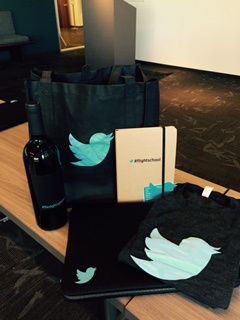
Promotional products are effective because the experience lasts longer and the products provide value to the customer. Find the right promotional product to help create a positive image of your brand.
Why is marketing to Millennials so important?
While sometimes underestimated, Millennials make up one of the most unique and largest generations to date. Not only do they make up more than a 1/4 of the national population, but they also account for having the most spending power.
Article Synopsis-4 Ways to Market to Millennials:
The article starts off with the author sharing a positive experience about a trip to a gluten-free bakery. After sharing the positive experience to the bakery’s Facebook page, the author immediately got a thank you response back. The bakery even mailed individually wrapped cookies as another thank you. By taking the extra steps to provide a customized experience, the bakery made the author feel valued. For the 83.1 million Millennials today, they are most attracted to this type of experience as a result of growing up in a technology focused time. Moreover, the article presents four tips to help market to this powerful group
1.Millennials want authenticity from reliable sources. One-step data shows that 40% of Millennials want content that informs them. Creating new content, educational posts, featuring your products and tips, and performing case studies are examples of establishing yourself as a reliable source.
2.Millennials like downloadable content. Millennials enjoy problem-solving and this is another way to grab their attention. How-to pdfs, e-books, and fliers are some examples of downloadable content. Moreover, make it fun and educational.
3.Millennials prefer personalization and/or customization. You don’t have to go crazy with it but taking the extra step will make you stand out to your customer. Some options include giving them the option to create their own product mockups or certain products that appeal to the customer.
4.Millennials value experience. They share what they are doing and what products they use on social media. Reposting photos of people using your products allows other followers to relate to the product/service.
The article “4 Ways to Market to Millennials” is published by Iclick.
How Gaslight Promotions Can Help You:
Here at Gaslight Promotions, one of our main goals is to provide a wonderful service so in turn, you can provide the same! Whether you are trying to attract Millennials to your business or simply looking to reward an employee or customer, appropriate promotional products help establish a relationship. When searching for promotional products geared towards Millennials, it can be overwhelming. Some products categories that attract Millennials include tech-related products, wellness products, travel accessories, and products that are useful to them.
Since Millennials value experience, correlating a product to your service/business will make the product more customized. For example, a fitness related business/club might give out a water bottle or an exercise band. Not only does the product relate to the business but it will be useful to the type of Millennial they are trying to reach.
Promoting to Millennials is important as the buying power continues to shift their way. By following the four tips and using promotional products, you can deliver a valuable experience that will attract Millennials. Send us an email or give us a call and let us help you find a product that fits your message.
American Adventures Month
August is set aside as the month to explore this fabulous country. From coast to coast, and north to south, the United States has so much to offer in terms of entertainment, adventure, relaxation, culture, history and more. While this is a natural tie-in for the travel and hotel industry, any company can plan a creative promotion that focuses on America. Run a daily or weekly online contest where participants answer questions about the company’s products and where they are, à la Where In The World Is Carmen Sandiego. Daily winners should receive a small logoed item, while the grand prize winner at the end of the month should be given travel-related prize. We can help you build the campaign and contest from start to finish and furnish the logoed prizes, too.
5
National Night Out
A grassroots effort to fight crime is practiced on a local community level. Traditionally, neighbors and community organizations spearhead efforts to “patrol” towns by either sitting on porches or walking the streets. Businesses can get involved by participating in the areas that they’re headquartered. This community outreach effort should be coordinated with appropriate logoed products including flashlights, whistles, T-shirts and caps.
12
United Nations: International Youth Day
This worldwide event focuses on 10 areas that include education, hunger, poverty, health, environment, drug abuse and others. Programs are developed to address these issues and to foster good decision-making skills by young people. A corporation can get involved by sponsoring events on a regional or local level. You can also do your part by initiating year-long mentoring programs for at-risk youth. We can help with details and securing ideal logoed products.
18
Bad Poetry Day
You’re a poet and you… never do anything about it. Here’s a fun idea – create a contest for your clients, vendors and employees to write poetry about the company, products and services. The campier, the better. Use social media to advertise and inform the masses. And select a winner (or would it be loser?) who provides the worst verse. Don’t forget logoed prizes for all participants and something special for the winner.
As an avid golfer, I couldn’t be more excited that the snow is finally gone and the grass is finally green. It seems we are also getting some consistent warm weather too, which is nice.
With the advent of golf season, comes the golf outing season and we are beginning to receive requests from clients for ideas on player gifts for their events. As a golfer myself, I’m always on the lookout for new and different player gifts. The one thing that baffles me is how many outings give away items that aren’t very useful. I’m all about value, but value isn’t only about the low price. In this industry, value is about how long the items you give out are kept and used. It’s all about keeping your message in front of the recipient as long as possible and a quality product will meet that goal. That concept applies not only to golf outings but trade shows and other methods of using promotional products.
Some nice golf related ideas are divot tools with ball markers attached to them and we have some excellent options in a wide range of price points. Towels are always appreciated and we have a number of unique towel possibilities available along with a very clever towel holder that also has a ball marker attached to it.
Or how about an item that not only a golfer can use, but anyone else for that matter? A water bottle that also doubles as a hot drink holder can be packed with imprinted tees, a small first aid kit and some snacks for a nice gift that can be used anywhere.
Speaking of tees, we have a supplier that has the ability to print inside the cup of the tee that the ball rests on. If you have a round or square logo icon, that can be a very effective way to promote your organization for a reasonable price. Tees can be packed in virtually any configuration too.
And there’s always apparel. From hats to shirts and outerwear, we have the major retail brands along with value priced garments that fit most any budget.
Don’t forget the awards for the winning teams or special events within the outing, like longest drive or closest to the pin.
After writing all of this, I think I’ll take a break and go hit some balls. My game needs work.
Enjoy the season!
Terry
National Make a Difference to Children Month
While children are out of school for the summer, this is the month to engage with them. Companies should commit to three things: 1. Do one special thing for children – consider holding an open house where kids can learn not only about your products and services, but also the professions within the company. 2. Support an organization focused on kids – sponsor sports leagues, dance troupes, scouts, etc. 3. Communicate with elected officials that they should make kids a priority. When engaging all month long, you can provide a variety of logoed products and we can help.
4
Independence Day
Let your patriotic flag wave high and wide today: Run an awesome red-white-and-blue promotion. Hand out logoed water bottles, caps and American flags with logoed sticks at a parade. Sponsor the local fireworks display and give all attendees fireworks enhancement glasses, or simply support your local veterans’ organizations.
11
Babe Ruth’s Pro Baseball Debut, 100th Anniversary
On this day in 1914 George Herman Ruth, The Babe, debuted with the Boston Red Sox as a pitcher. His storied career lasted 22 seasons and he is still synonymous with the game. Baseball-themed promotions are the order of the day, whether at a major or minor league park or with local sports clubs. Logoed bags of peanuts, baseball caps, jerseys and the like can carry your company logo. Call us today to find out about even more baseball-related products.
23
“Hot Enough For Ya?” Day
OK, so this is the one time of year where you are permitted to utter the banal phrase, “Is it hot enough for ya?” Have fun with it. Host a water ice or ice cream event at a town center, distributing cold treats for everyone. Hand out logoed misting fans, caps and other items that can carry your company logo. You should make sure to document everything via social media, too.
Entrepreneurs Do-It-Yourself Marketing Month
Smaller companies usually don’t have a marketing department, and that’s why your distributor partner is so important – especially in June. Use this month to take control of your marketing efforts and gain more business and exposure with local media and potential clients. Send press releases with company news along with a logoed item. The bulk in the envelope will ensure it’s opened. Use your social media like Facebook, LinkedIn and Twitter to announce new hires. Hold rallies in local parks to publicize your firm’s community outreach efforts. We can help you pick appropriate logoed products.
6
Anniversary of First Drive-In Movie Theater
At their peak, there were 6,000 drive-in movie theaters in the U.S. Today there are about 600. That shouldn’t keep you from using tonight as a way to launch a community outreach program. Sponsor a local outdoor movie viewing party either on your company’s property or co-sponsor with the local community government. Provide games and prizes before the movie begins and serve attendees popcorn and soft drinks in logoed containers. Let us help you with the event, including all the giveaways you’ll need.
13
Friday The 13th
Paraskavedekatriaphobia is the fear of Friday the 13th, but since this is the only one in 2014, don’t fear it – celebrate it! Throw a fun, mid-year, open house for your clients and potential customers. Decorate with black colors and “unlucky” themes like black cats, broken mirrors, etc. Don’t forget to include “Jason” and other memorabilia from the movie Friday the 13th. Give guests gift bags with logoed products and reasons why it’s unlucky to not do business with your firm.
19
Recess at Work Day
Nothing makes kids happier than when they hear that bell for recess. Have an employee-focused event today where having fun during “work recess” is the objective. Break out into departmental teams with logoed apparel and compete in classic schoolyard games like kick the can, tag, hopscotch, kickball and more. Offer prizes like trophies and other logoed goodies.
Major brands, including Starbucks, Disney and Wegmans, are using Earth Day to promote logoed eco-friendly items, like reusable drinkware and totes. Here’s a list, with media links, of some notable company promotions and giveaways in honor of Mother Earth.
What other companies do you know of that offer freebies for earth day?
Screen Printing
Screen Printing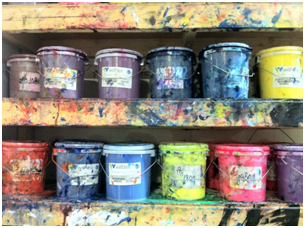
Ink manufacturers work differently than thread manufacturers. Although it’s possible to buy premixed colors, ink manufacturers have developed ink mixing systems that are used to create Pantone matching inks colors for print. We keep common colors on the shelf, but for more unique shades, it’s no problem to custom mix it. An important thing to note when referencing Pantone colors and screen printing inks is that the inks can still vary slightly despite the exact nature of the formulas. This depends on the color of garment being printed, material we are printing on, and whether or not we need to print a white under base.
For more information on this, you may want to read over this free download guide that goes into more detail about screen printing inks and Pantone colors.
For Embroidery
Pantone colors are the universal language for communicating specific colors right down to the shade. This language overcomes distances and computer monitors with different calibrations. If both parties involved in a project are looking at a Pantone book, referencing the exact number, both parties can rest assured that they are on the same page. Brand guidelines define specific colors of logos in terms of Pantones. Designers call out Pantone colors in their work so the image can be re-created exactly from digital media to print and embroidery. As decorators, we live and die by Pantone colors. However, the language of Pantone colors translates a little differently between screen print and embroidery – like a different dialect between the mediums of decoration. Let’s look at why and what this means for the logo or design you are having screen printed or embroidered.
Embroidery
Thread manufacturing companies have companion books that gives us a quick reference of all colors available and their corresponding Pantone color.
PANTONE BOOK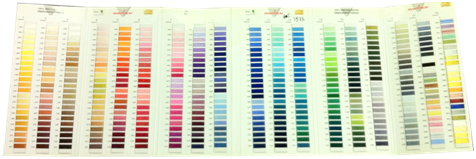
PANTONE THREAD CHART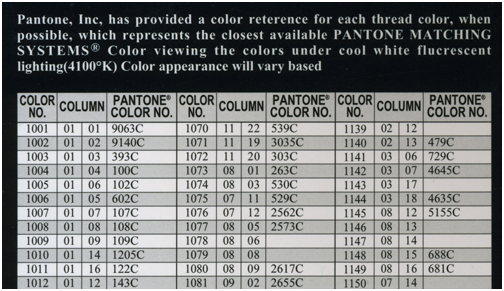
A few things you’ll want to note: You’ll notice on the picture of the Pantone book there is a finite number of thread color created by the manufacturer. You’ll also notice from the snippet of the full thread chart, not all thread colors have a Pantone match assigned.
The snippet of the thread chart includes a disclaimer that Pantone colors represent the closest available thread color, and is most accurate when viewing the colors under cool white fluorescent lighting (4100 degrees Kelvin). The thread color may not match the corresponding Pantone color under every lighting condition. Another consideration to make is that not every color in the thread may be available. You see, it’s not simply a matter of having one spool of each color. Embroidery houses frequently stock the most common colors only. This ensures that a color won’t run out because the spool is low and the embroidery manufacturer can pass on volume thread purchase discounts to you. On top of specific colors, embroidery shops may stock both rayon and polyester thread by several different manufacturers so the absolute best quality can be achieved based on the color, fabric, and/or garment you wish to have customized.. What can be done if the embroidery manufacturer does not stock the exact thread color you’ve selected? Here are some options: Stick with the closest match. A slight difference might only be noticed if you put a Pantone book up against the sewn logo and who carries around a Pantone book. Also remember that the logo colors may look different depending on the lighting in the environment anyway.
You can provide the thread. Embroidery houses do carry the most common colors, so if yours is a little more unique, inquire if you can provide the thread. Your decorator can let you know how much and where to purchase the thread. The thread is then yours for each and every time you place a custom order. You can take the thread from shop to shop if the decorators are willing to accommodate.
Ask if your decorator can provide the thread. If you will be running a consistent, large program it may be easiest for every one if the shop simply acquires a new color.
Look for Part two of this series tomorrow.
San Francisco-based wine producer Cameron Hughes recently sponsored a booth at the Aspen Food and Wine Festival, a not-to-be-missed annual event for foodies, wine and culinary celebrities and industry leaders, held high up in the Rockies.
“It was the first time we attended the festival,” says Jessica Hughes, co-founder and chief marketing officer at Cameron Hughes. This year marked the company’s 10th anniversary as well as the 30th anniversary of the Aspen festival.
“We offered festival guests 12 different wines from around the world. 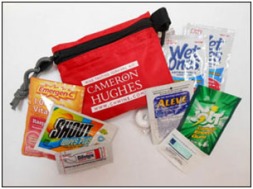 Since we source wines globally, the wines hailed from Bordeaux to Napa, all under the Cameron Hughes label,” she says. “We are little people, and we wanted to have the greatest presence possible there.”
Wine trade tasting events are very intense; sometimes there can be 1,000 wines under one tent, Hughes notes, adding, “If we didn’t spit, we wouldn’t be able to get through the first hour.” Also, it’s easy to get inebriated more quickly in a location like Aspen due to its high elevation and lower oxygen levels. “You can get a ferocious hangover if you’re not careful,” says Hughes.
To combat the perils of tasting at high elevation, Cameron Hughes created a “wine-tasting survival kit” to promote its brand to event VIPs. The reusable red pouch, bearing the name of the winery and its website address, included such essentials as Aleve, teeth whitening strips, Emergen-C vitamins, breath mints, Blistex and Wet Ones.
The items were carefully thought out. For example, Blistex soothes the inevitable chapped lips that result from tasting red wine. Alka Seltzer helps tackle the acidity of wine tannins that can cause an upset stomach, and Emergen-C provides a vitamin infusion. “In the wine industry, we all take Aleve with Emergen-C in the evening, combined with a big glass of water. This guarantees no hangover,” Hughes says.
The versatile pouch had a hook and eye to attach to belt loops, and was small enough to fit into a back pocket. It also had a zipper piece that allowed it to be hung from a lanyard, worn by many attendees at the festival for identification. The pouch also contained a slit for credit cards and a license, and could be used as a wallet.
It was the first time the wine merchant had ever done a giveaway like this, and Hughes wanted the kit to be “smart, innovative and well thought out.” Cameron Hughes distributed 450 pouches to industry VIPs, and an additional 4,500 Chapsticks were distributed in the event’s registration bags, as well as at its booth. “People loved the pouches,” Hughes says. “Some said it was ‘genius,’ and the Chapsticks were also hugely popular.”


 gaslightpromotions